Interview with Yash Saxena, Author of Stories from a Kargili Kitchen
An insightful interview with Yash Saxena explores how Stories from a Kargili Kitchen captures Kargil’s culture through food, memory, and everyday resilience beyond conflict.on Apr 02, 2026
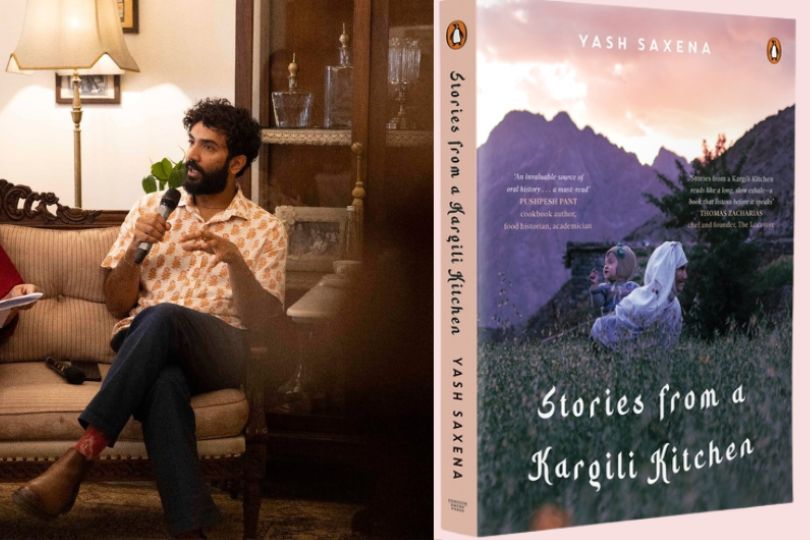
Frontlist:.Stories from a Kargili Kitchen shifts the narrative of Kargil away from conflict and toward everyday life. What first drew you to tell this region’s story through food rather than history or politics?
Yash Saxena- The thing is, I see everything through the lens of food. Kargil has seen everything. All the wars, conflicts, years of struggle, loss of culture, dance, music, literature of a people, and migration. But some things remain constant, and food is one of those things.
Throughout history, despite inhuman conditions, people have always carried their food and food choices with them, both physically and mentally. The memory of your own food is like the memory of your own language.
Food is the language of preservation. That is why I wanted to focus on it. Food becomes the medium through which history, politics, relationships, and everything else can be explored.
Frontlist:You describe the book as emerging from years of travel, cooking, and friendships. How did trust and intimacy shape the stories that finally found their way into these pages?
Yash Saxena- When I started working in Kargil, I did not plan on writing a book that would one day be published. The idea evolved over time. What I did know was that it takes time to truly understand a region, be it any facet of its culture, especially something as personal and integral as food and food culture. You have to live it.
One essential challenge was the fact that, in a place like Kargil, entry into the kitchen, into the world of women, is not easy for a man who is also an outsider. It takes a long while. It takes connections built over months and years for the family, and especially the women of the household, to trust you enough to let you be around them in the sanctum of the kitchen.
When we started working seriously on the book, it really helped that Sneha Nair, who is my partner in the book, was around. The presence of a woman helped us go deeper into each home. Initially, the families we met felt more comfortable with both a male and female presence among them.
The story of a region, like the story of every person, is not defined by incidents and what they have gone through, but by the ways they live their life each day, what they choose to hold on to and their philosophy of life.
Frontlist: Food in the book functions as memory, ritual, and resistance. How do Kargili kitchens preserve cultural identity in a landscape marked by borders, faith, and extreme
geography?
Yash Saxena- In your question, you ask how food is a ritual, a memory, and resistance. The peculiar thing about Kargil is that food has not been a form of resistance in the past few years. I have seen that younger generations have begun forgetting their culture, their food, their agriculture, and what the seasons used to be. Though it is understandable, the effects are dire.
Just like a language whose erasure means you begin to think in another language, losing your food systems, ingredients, and recipes means forgetting your relationship with the land and your relationship with your own body.
For millennia, Kargilis and Ladakhis have not only survived but thrived in an extremely inhospitable region. Like certain species of animals or flora that adapt to harsh environments, humans here have survived and found a place to call home. Culture, nutrition, and even genetics adapt to the environment.
It is a small shift in perception but an important one. People did not settle on the border, the border happened to them. Their old trade routes to Gilgit-Baltistan, Turkistan, Yarkand, Yarqand and Tibet were decimated. In a region where you cannot easily get basic things like salt, travelling and trade became essential. The food systems of Kargil were developed to support long days in the fields, long journeys across mountain passes, and long winter months with no growth.
Quick dishes like khulaq, stone-ground chutneys and takis, and the dependence on hot liquids like gur gur cha, chhang, and thang show the ways in which food has adapted to the particular lifestyle of the region.
Frontlist: The narrative weaves together shepherds, monks, farmers, and mothers—voices rarely foregrounded in mainstream storytelling. How did you approach representing these lives with sensitivity and authenticity?
Yash Saxena- It is an interesting question to ask how the book focuses on and represents the lives of monks, mothers, farmers, and shepherds. Because what else is there to talk about if not the real lives of the people who call Kargil home? These are the people whose stories make up Kargil.
I believe the focus on grand narratives and royal histories dilutes a place, its food, and its culture. Across India, royal kitchens, royal libraries, and royal memories have often been the sources we look to when we talk about history. But it is a biased history. It is a biased view of what life in a land has been. Royals and elites often have little understanding of what it means to brave the weather, grow food, and deal with little food in times of poverty and drought.
The story of Kargil, like every other place, belongs to the people who live there day and night. They may not shape culture in the way the rich and powerful often do, but they live it. That is the story I wanted to tell through this book. Each family has horrible and inspiring stories of war, of loss and of personal conflict. But, these are not the stories that defined them or the individual mentioned in the book. For some, it's the conflicts, and for some, it's their mother's singing from the kitchen that shapes their life.
I wanted common people across India to find themselves in these stories and feel a sense of resonance and discovery through the life of someone who has lived a very different life from their own.
Frontlist: The book blends memoir, travelogue, and cultural history. How did you navigate the balance between personal experience and collective memory while writing?
Yash Saxena- I personally do not subscribe to any particular region, religion, or culture of India. That is something I have felt throughout my life, and in doing so it has helped me approach the culture that I am living in with fresh eyes - unbiased and unburdened.
In my time in Kargil, I attempted to be a fly on the wall - someone who can exist silently and respectfully, ask questions, but not as a journalist, but almost like a curious child. My goal was to let people tell their own stories through me.
Frontlist: Ancient rituals coexist with modern echoes of conflict in your storytelling. What did this contrast reveal to you about resilience and continuity in Kargil?
Yash Saxena- I think the most interesting ancient ritual that continues in Kargil in a festival called Mamani. It is celebrated across different Himalayan cultures, from Gilgit-Baltistan to parts of Tibet. It is the day when villagers come together and share food at the centre of the village. Everyone cooks dishes that utilise everything that has grown on that land during that year.
The symbolism of Mamani is that the village honours the ancestors who made it possible to live in this harsh region. Mamani is a way to give thanks and to feed the poor during peak winter, when rations are dwindling. In recent years the festival has seen resurgence in Kargil as poeple start looking back at their traditions again and question how so much has changed.
There are rituals within the festival that do not directly connect to existing Islamic culture or the earlier Buddhist traditions. These practices predate both formal religions and come from an older pagan belief system called Bon.
What is fascinating is that the region has seen two major religious conversions, and yet these rituals have persisted for over a millennium. The persistence of beliefs in the spirits of the mountains, lakes, and rivers reminds the local population of their connection to the land beyond religion.
Frontlist: As a foodways researcher and artist, what do you hope readers carry with them after finishing this book about Kargil, about food, and about the quiet power everyday acts?
Yash Saxena- By the end of the book, I want people to re think what they think is worth remembering, talking about, and protecting. I want people to appreciate the raw beauty of a region long ignored and avoided by tourism.
For the mainland of India outside of Kargil, I hope people will find value in the culture and ingredients, and understand how Kargil is an integral part of the nation, just like all the other border cultures which are on the brink at of society in terms of geography or social acceptability. For Kargil, I hope the book will be a reservoir and inspiration for the younger generations. I hope the book reminds them to take pride in theeir culture, their food, and their tribal history - something urbanization looks down upon.
Kargil
Yash Saxena
Food Culture
Indian literature
interviews
Cultural Stories
Travel Writing
Kargil Life
Food History
Book Feature
Post a comment
0 comments

Trending Posts
.jpg)
.jpg)

.jpeg)


.jpg)
Recent Post
.jpg)
.jpg)






Related Post
 (1).jpg)



© 2026 - Frontlist - News and Updates of Publishing Industry, Book Reviews, Education News, Author Interviews, and Videos.. All Rights Reserved.
Sorry! No comment found for this post.