Interview with Sandeep Jain,Author of Selfism: The Art Of Being Selfist
In this author interview, Sandeep discusses the philosophy of Selfism, explaining how people can set healthy boundaries, protect their identity, overcome people-pleasing habits, and practise self-preservation while maintaining meaningful relationships.on Nov 14, 2026
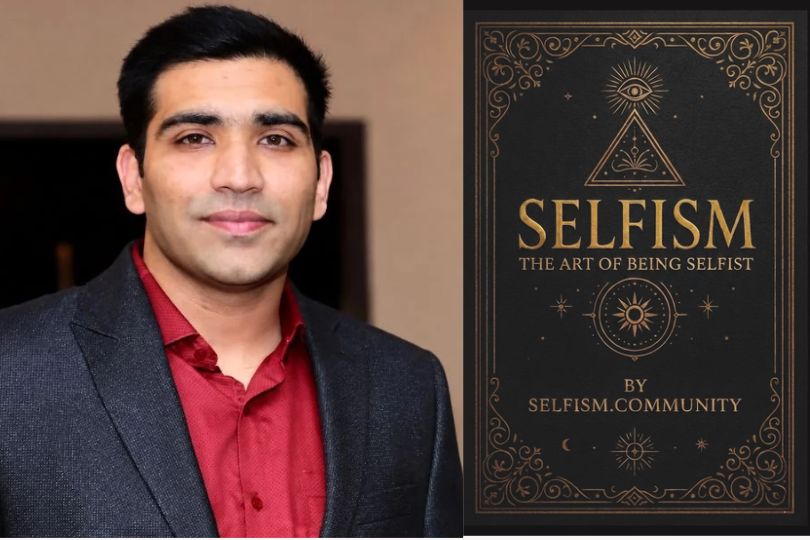
Frontlist: The origin of Selfism: You noticed how easily generous people lose their identity while tending to others. Was there a particular person or moment, perhaps your own experience, that made you build a whole philosophy around it?
Sandeep: It wasn’t a single dramatic lightning bolt; it was the quiet, cumulative tragedy I observed all around me—and experienced firsthand. In corporate environments, families, and social circles, I saw the most reliable, empathetic, and generous people becoming completely invisible. They were praised for being "accommodating" and "always available," but beneath that praise, their energy, health, and personal ambitions were quietly evaporating.
I realized that modern culture rewards self-sacrifice right up until the person collapses, and then asks, "Why didn't you speak up?" I reached a point where I had to confront my own boundary-less generosity. I realized that giving until you have nothing left isn't nobility—it's slow self-erasure. Selfism wasn't born out of self-absorption; it was built out of necessity as a rescue system for people who are running on empty while lighting everyone else’s path.
Frontlist: Why "Selfist"? The word "selfish" carries a lot of guilt, and "Selfism" sounds deliberately close to it. Why did you choose this term, and how do you answer readers who think it encourages selfishness?
Sandeep: The phonetic similarity is entirely intentional. "Selfish" is a word used as a weapon to guilt good people into compliance. Whenever a giver sets a basic boundary, the world labels them "selfish." I wanted to reclaim that linguistic space and provoke a reaction.
Being Selfish means taking at the expense of others. Being a Selfist means protecting your core so you have something real and sustainable to give. A Selfist recognizes that you cannot pour from an empty vessel. If a reader feels uneasy with the term initially, I ask them: Is it selfish to preserve your sanity, your health, and your core identity so you can show up authentically for the people who truly matter? Selfism isn't about isolation; it's about anchored, healthy presence.
Frontlist: Beyond "treat yourself": The book rejects the cliché of spa days and indulgence. What is the difference between self-care as a treat and self-preservation as a daily practice?
Sandeep: Commercialized self-care has turned well-being into a consumable product—a bubble bath, a spa day, or a weekend getaway. But those are quick treats; they are temporary escapes from a life you haven't set boundaries in.
Self-preservation, on the other hand, is architectural. It’s not an escape from life; it’s how you design your life. It’s the daily, unglamorous practice of protecting your time, guarding your mental bandwidth, turning off notifications, saying "no" without a paragraph of excuses, and honoring your basic physiological and emotional needs every single day. A spa day gives you a temporary pause. Self-preservation builds a life you don't constantly need to escape from.
Frontlist: The invisible giver: You open with the idea of being the most generous person in the room and still disappearing. What are the early warning signs that someone has started to lose themselves?
Sandeep: The earliest sign isn't overt breakdown—it's quiet resentment. When you catch yourself feeling irritated by requests you used to handle cheerfully, or when you feel relief when plans get canceled, that’s your check-engine light.
Other critical warning signs include:
Automatic Agreement: Saying "yes" before your brain even processes if you have time or energy.
Chronic Decision Fatigue: Losing clarity on simple personal preferences (e.g., "I don't care what we eat/do, whatever you want").
The 'Background Role': Feeling like a supporting character in everyone else's storyline while your own personal goals stay permanently paused.
When your calendar reflects everyone’s priorities except your own, you haven't just become generous-you've started to disappear.
Frontlist: Why do givers over-give? In many families and workplaces, especially in India, being accommodating is praised as a virtue. How much of over-giving is conditioning, and how much is personality?
Sandeep: It's a combination, but conditioning provides the blueprint, while personality fuels the habit.
Culturally, particularly in collective and close-knit societies, "adjusting" and "compromising" are framed as the highest moral virtues, especially for empathetic individuals. From childhood, we are taught that harmony in the room matters more than truth in our hearts.
High-empathy personalities then absorb this conditioning and elevate it into a survival strategy: “If I am useful, I am safe. If I am agreeable, I am valued.” Over-giving becomes an unspoken contract where we exchange our peace for validation and approval. Selfism challenges this by asking: At what cost are you maintaining that harmony?
Frontlist: The art of the clean "no": Saying no is hard for chronic people-pleasers. Can you share a simple, practical way to begin, such as a script or a first small boundary to try?
Sandeep: The biggest mistake people-pleasers make is over-explaining. An explanation gives the other person handles to negotiate with. A clean "no" is respectful, unambiguous, and requires zero justification.
The Script:
"I appreciate you asking me, but I don't have the capacity to take this on right now."
The First Small Step:
Implement a 24-hour buffer. When asked for a favor or commitment, train yourself to never say yes on the spot. Practice saying:
"Let me check my schedule and get back to you by tomorrow."
This eliminates the impulse to immediately please and gives you the quiet space needed to decide if it's a genuine yes or a boundary-setting opportunity.
Frontlist: Emotional baggage that isn't yours: The book talks about dropping burdens that don't belong to us. How can a reader tell whose emotions and responsibilities they are carrying?
Sandeep: You can identify inherited emotional baggage by asking one precise question: "Is this a problem I can directly fix, or am I holding onto this just to feel control or relieve someone else’s discomfort?"
Givers frequently mistake empathy for ownership. Empathy means standing beside someone in their storm; carrying their baggage means trying to control their weather. If you are staying awake at night strategizing solutions for someone else's life choices while they themselves aren't taking action, you are carrying emotional weight that isn't yours. Dropping it isn't coldness; it's respecting their personal sovereignty and journey.
Frontlist: The eight-dimension self-assessment: Can you walk us through what the eight dimensions are and what a reader typically discovers when they take the assessment for the first time?
Sandeep: The self-assessment maps your baseline across eight key dimensions of daily existence: Boundaries, Self-Worth, Time, Emotions, Truth, Relationship, Mind, and Money.
These aren't abstract concepts—they are the exact pillars where people either protect their sovereignty or leak their vital energy.
When readers complete the assessment for the first time, what typically hits them is the illusion of high functionality. They might score high on managing external responsibilities or handling complex tasks, but reveal critical deficits in Boundaries, Time, or Truth—realizing they are running on fumes while lying to themselves about being "fine." The assessment strips away the guesswork. It pinpoint-analyzes where you are giving yourself away and gives you a clear starting map to reclaim those lost areas.
Frontlist: Building Selfism.Community: What has surprised you most about the people who join the community, and is there a story of transformation that has stayed with you?
Sandeep: What surprised me most was the sheer relief people express when they realize they aren't alone or broken. Members often come in carrying decades of guilt, believing they were failing because they felt exhausted.
One story that sticks with me involves a high-performing professional who was also the designated "fixer" for her entire extended family. She had postponed her own health priorities and personal projects for years to manage everyone else's daily crises. Through the framework and community support, she learned to implement clean boundaries. She didn't abandon her family; she simply stopped intercepting every problem. Within months, her health improved, her career accelerated, and remarkably, her family members became far more self-reliant. Seeing someone reclaim their identity without blowing up their life is the ultimate validation of this work.
Frontlist: Balancing boundaries and relationships: Some readers fear that setting boundaries will damage their relationships. How should they handle pushback from family, friends or colleagues who are used to their constant availability?
Sandeep: First, accept an uncomfortable truth: When you change the rules of engagement, people who benefited from your lack of boundaries will resist. Pushback is not evidence that your boundary is wrong; it is evidence that the boundary was necessary.
To manage pushback effectively:
Expect the friction: Don't panic when people express disappointment or annoyance.
Hold firm without aggression: You don't need to argue or convince them. Simply restate the boundary calmly.
Remember the principle: The only people who get upset when you set a boundary are those who profited from you having none.
Over time, authentic relationships adjust and become healthier. Boundaries don't destroy real connections; they filter out exploitation and build genuine, mutual respect.
Post a comment
0 comments

Trending Posts










Recent Post








Related Post



 (1).jpg)





© 2026 - Frontlist - News and Updates of Publishing Industry, Book Reviews, Education News, Author Interviews, and Videos.. All Rights Reserved.
Sorry! No comment found for this post.