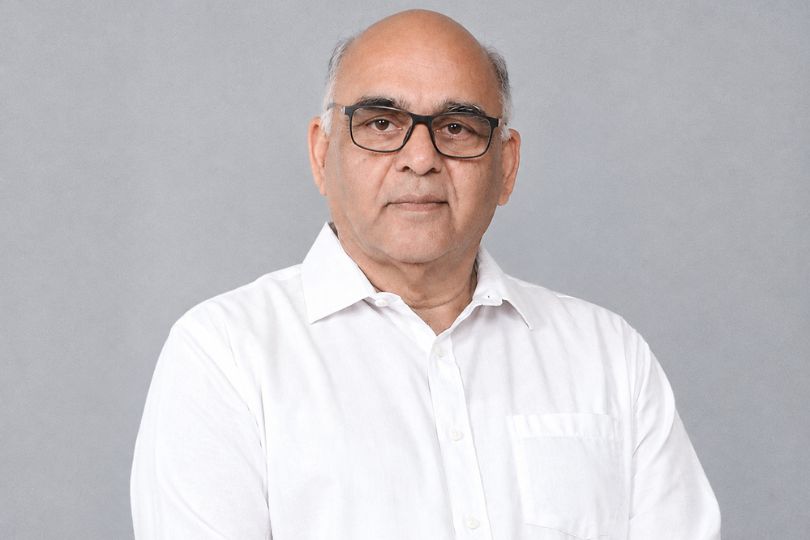
Interview with Arup Bose Publisher of Srishti Publishers & Distributors
Publishing leader Arup highlights how discoverability, marketing, and human storytelling drive book success, while AI supports creativity but cannot replace authentic author voices.on Apr 15, 2026
.jpg)
Frontlist: As a publisher at Srishti Publishers, your role involves not just selecting books but ensuring they reach the right audience. How important is discoverability in today’s publishing landscape?
Arup: Discoverability is everything. In a world that’s moving faster than ever, a book’s greatest enemy isn’t a bad review, it’s silence. For me, discoverability is about being there in that split second when a reader is looking for a connection. Whether it’s on a physical shelf or a e-commerce app like Amazon, if we aren't visible in the moment of intent, we’ve failed the story. We aren't just selling paper and ink; we are fighting for a place in someone’s heart and mind.
Frontlist: Your journey blends publishing with marketing expertise. How does marketing influence the success of a book in today’s competitive environment?
Arup: In the current landscape, I view marketing as the strategic architecture that ensures a book's survival. It’s no longer just a megaphone for a finished product; it’s a sophisticated interplay between data-driven psychology and visceral storytelling. My expertise in this space has taught me that a book’s success is determined by how well we define its Product-Market Fit long before it ever reaches a shelf.
We are operating in a hyper-competitive Attention Economy. To cut through that noise, we employ a full-funnel strategy that moves a reader from initial
awareness to deep, vocal advocacy. For our Bold imprint, for instance, we utilize Authority Marketing, positioning global icons and national thought leaders as modern-day mentors for a new generation seeking growth. Conversely, for our Launchpad imprint, our strategy is Community-led Growth, where we nurture a tribe around a debut voice, making the reader feel like a co-traveler in the author's journey.
Deep marketing is also about mastering the Moment of Intent, being visible exactly when a reader is looking for an answer or an escape. Whether it’s through targeted digital sentiment analysis or our pioneering work happening in Quick-Commerce distribution to meet instant demand, we ensure that our titles aren't just available; they are inevitable. Ultimately, marketing is the engine that transforms a solitary creative act into a powerful, shared cultural moment.
Frontlist: With your venture, Bluejay Books, you’ve explored new publishing approaches. What inspired you to build something of your own within the industry?
Arup: Srishti is the legacy I stand on, but I’ve always believed that a publishing house needs many rooms to welcome every kind of reader. While Bluejay is an important part of the larger Srishti umbrella that allows us to be agile and experimental, I’ve been deeply focused on building specialized imprints that speak to the evolving heart of reading.
A major pillar of this vision is Bold, our imprint for premium non-fiction. This is where we curate high-impact, transformative work that challenges the status quo and offers real intellectual depth. We have been fortunate to publish globally renowned thinkers alongside powerful national voices—bringing the wisdom of international icons, while also championing national heroes and many others who are shaping our future. It’s about publishing ideas that truly move the needle.
Following that is Launchpad, my personal commitment to the future of Indian literature. It is dedicated entirely to finding and nurturing new, upcoming voices that might otherwise be overlooked. Most recently, we started Shabd, our Indic language imprint. This feels like a homecoming, ensuring that the magic of a story isn't lost in translation and that we reach readers in the languages they think and dream in.
These imprints aren't just sub-brands; they are the pillars of a mission to ensure that every story, whether it’s a debut novel or a deep-dive into non-fiction, has a dedicated space to thrive.
Frontlist: In an age of overwhelming content, how can publishers ensure that meaningful books don’t get lost in the noise?
Arup: In a world where content is infinite but attention is a finite resource, we have to be more than just publishers & distributors; we ensure a book doesn't get lost, we must move beyond the digital scroll and create spaces where stories can actually breathe.
One of the most powerful ways we do this is by reclaiming the physical world through Book Fairs. While many see book fairs as mere sales points, we view them as vital cultural hubs. In a digital marketplace, discovery is often driven by an algorithm; at a book fair, discovery is driven by serendipity and human connection. It’s where a reader can feel the texture of a non-fiction book cover or flip through the pages of a debut voice. By being physically present at almost 100 Bookfairs across the country, we create a high-touch environment that transforms a passive browser into an active member of our community.
At the heart of our strategy to fight noise is the Srishti Spring Fest, our flagship literary sanctuary designed as an inclusive, "borderless" space for everyone who loves the written word. We envisioned this fest not just as an event, but as a homecoming for the spirit of storytelling. It is a high-touch environment where we intentionally break down the "fourth wall" between the author and the reader, creating a level of intimacy that a digital screen simply cannot replicate.
Frontlist: With the rise of AI in writing and content creation, how do you see its impact on authorship, originality, and the role of publishers?
I am certainly not anti-technology; in fact, I see AI as an incredibly powerful supporting tool that can enhance the creative process. It can streamline many of the more laborious tasks for an author, whether it’s helping with deep-dive research, organizing complex notes, or even transcribing spoken thoughts into written words to capture inspiration in real-time. These are efficiencies we should embrace.
However, there is a clear line where the tool ends and the creator begins. AI can mimic a style, but it can’t mimic a soul. It lacks the vulnerability, the lived struggle, and the raw human experience that truly makes a book resonate with a reader. Our role as publishers is increasingly becoming that of a guardian of the human spirit. We are the ones who certify that a story came from a place of real, messy, beautiful human feeling, rather than just a predictive algorithm. Originality is our most precious currency now, and while I welcome AI as a support, I will always bet on a human heart to tell the stories that actually matter.
Frontlist: You’ve worked in both corporate and publishing spaces. How has your background in marketing and risk management shaped your approach to publishing?
Arup: Working across both worlds has taught me that publishing is the delicate, high-stakes art of managing creative risks. My corporate side is rooted in data
driven decision-making, I am constantly analyzing hard costs, inventory velocity, and market trends to ensure our business remains a financial fortress. This stability is what actually earns us the right to be brave and experimental.
However, true risk management in this industry isn't just about avoiding failure; it’s about strategically hedging against the predictable to make room for the extraordinary. While the numbers tell me what is already proven, my publishing heart looks for the unprecedented. I use my marketing expertise to build a protective, strategic structure around an author's dream. This ensures that when we take a chance on a raw, disruptive new voice, they have a solid platform to stand on while they reach for greatness.
Frontlist: What are some of the biggest challenges publishers face today when it comes to reader engagement and book sales?
Arup: We are fighting a Great War for Attention. Our real rival isn’t another book; it’s the 30-second reel and the infinite scroll. In a world of shrinking attention spans, the primary challenge is proving that a deep, immersive 300-page journey is far more rewarding than the digital junk food on our phones.
Beyond content, we must solve for friction. In an instant world, waiting days for a book is often too long. Success requires meeting readers in their moment of intent, ensuring that the path from a spark of curiosity to having the book in hand is as seamless and fast as any other modern service.
Ultimately, the goal is to move from a Transaction" to a "Transformation. It’s about occupying a permanent space in a reader’s life rather than just appearing as a number on a spreadsheet. It’s a high-stakes balance, but it’s the only way to keep the magic of reading alive in a world that never stops moving.
Frontlist: On World Book and Copyright Day, what message would you like to share with readers about the importance of choosing and supporting books thoughtfully?
Arup: A book is a piece of someone’s life. When you choose to buy a book, especially an original work, you are casting a vote for that author’s voice to keep existing. Supporting books thoughtfully is an act of respect for the labor, the love, and the late nights that go into every page. My message is simple: treasure the stories that move you, protect the rights of the people who write them, and never forget that a good book is a companion for life.
Post a comment
0 comments

Trending Posts
.jpg)
.jpg)

.jpeg)


.jpg)

Recent Post
.jpg)
.jpg)






Related Post





© 2026 - Frontlist - News and Updates of Publishing Industry, Book Reviews, Education News, Author Interviews, and Videos.. All Rights Reserved.
Sorry! No comment found for this post.